 Kicker
Pack U1 (Unofficial - Unwanted):
Kicker
Pack U1 (Unofficial - Unwanted):Kicker
Pack U1 (Unofficial - Unwanted):
Design: David Papay
Rules Review & Editing: Robert Harland
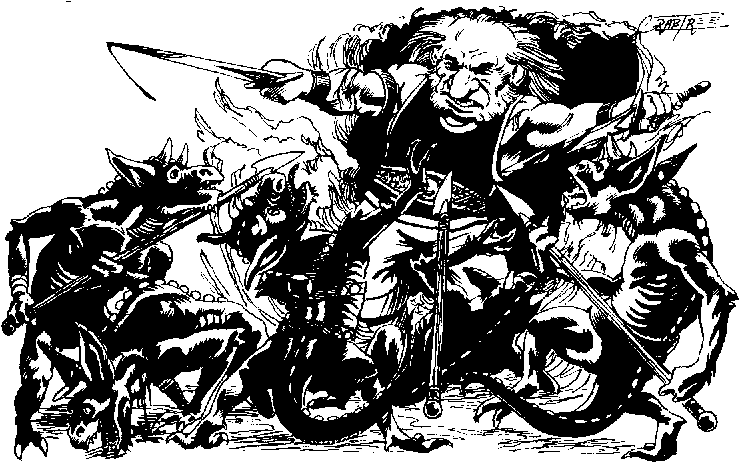
An uneasy calm had fallen over Esfah. Death, angered and apprehensive by the wavering allegiance of the frostwings and the unexpected independence of the scalders, called his creations back to him, so he could gauge their loyalties and reassess their worth.
It was during this time that Ailuril, second child of Nature, came out of hiding and returned to the young, war-torn world. She saw the Selumari, her children, robbed of their beauty and grace over the course of countless battles. She saw the mortal amazons and beast-folk, hardened by conflict and indifferent to the suffering of those around them. She saw the firewalkers and scalders who loved nothing but destruction and combat. She saw all this and wept, for it seemed that none of the joy and beauty that she had imparted on Esfah remained.
Her tears, the pure elemental spirit of air, fell upon the land and passed through it, descending through earth and stone, taking on a will of their own. They probed deep within the caverns and warrens of Esfah until they found what they sought after. There, living deep under the surface, untouched by and unaware of the war raging above them, lived a tribe of dwarves.
They were children of Eldurim and Firiel - made of earth and fire - dutiful, impassive, and serious in their toils. Then the tears of Ailuril fell over them, imbuing with the element of air, and they were filled with her capricious and whimsical nature. Thus the first gnomes came into being, and they journeyed upward, longing for the forests and plains of the surface of Esfah, but always staying close to the earth that had been their home for so long.
Ailuril glanced down and saw her new children, and she was pleased, for they brought happiness and humor to a land so desperately in need of such emotions. Then she felt a warmth against her cheek and turned toward it - thinking it her sister Firiel, and anxious to show her the new race she had brought into the world. Ailuril was struck squarely in the face with a burst of steam from a spacefaring ship, a sidewheeler as it were, making a rapid descent toward the surface of Esfah.
The strange flying craft landed - crashed, actually - quite close to where the newly-created gnomes had gathered. Out of the now wrecked (but still quite salvageable) sidewheeler climbed its crew - a gnomish crew. The two groups approached each other, and the captain of the strange vessel spoke:
"Gladtoseesomeothergnomesinthearea.Wewerejustgoingtoflyrightonbybutwhenwenoticedsomeofourownkind,wellyouknowhowitis,wejusthadtostopandsayhi. Say,doanyofyouhappentohaveanextraspelljamminghelm? No,wellthat'sOK,we'lljusthavetostayhereforawhileuntilwecanfixours. Hey,isthataBladeGolem?Youknow,withafewminoradjustmentsandsomeslightimprovementswecould�"
Ailuril looked on in horror at what had transpired. "Oh no. What have I done?" she asked herself. She fled once again from Esfah, unable to bear the thought of Tinker Gnomes on her beloved world.
Just when you thought Esfah was dangerous enough! Now gnome troops march to war, bringing their unique magic, innovative tactics, and modified magical items with them. They fight for Nature, but do the forces of Nature want their help?
This is the first revision of the Gnomes! rules, dated January 21, 1999.
Change History:
Like other six-sided and ten-sided dice in the Dragon Dice game, gnomes follow the basic rules for units, as explained in the Dice Commander's Manual. In addition, the following special rules apply to gnomes.
In game terms, immediately after your opponent announces his intention to skirmish (but before he rolls his army), you can choose to have your gnome units in the defending army attempt to prattle. You can roll any number of your gnomish units. For each non-ID maneuver result, you can engage one health worth of your opponent's units (your choice) in prattle (except undead, who are immune to prattle). These units are either too confused to engage in combat or are actually interested in the conversation. Either way, the opposing units, as well as your prattling gnomes, can make no further rolls until the end of this action (although they can be taken as casualties).
Unfortunately, some opponents recognize the gnomish prattle for what it is and become enraged. If a gnome unit rolls its ID icon during the prattle attempt, then it must immediately flee to the reserves to avoid being killed by its infuriated opponent (but having learned absolutely nothing from the experience).
Once the prattle has been resolved, the skirmish proceeds normally. Any gnome units not engaged in prattle (or those poor, dejected souls who tried but failed to engage their opponent's attention) participate in the skirmish normally. This power can only be used when your opponent initiates a skirmish action; it cannot be used if you initiated a skirmish action and are now defending against the counter-attack.
In addition to the above rules for gnomish prattle, the SAIs for the Tinker class also affect the results of a prattle attempt. See the individual Tinker SAI descriptions for their effects during a prattle attempt.
Tinkers can rattle off information and opinions in a succession of thousand-word sentences, speaking and listening simultaneously.
In game terms, gnomes lack the endurance required for charge attacks. During a charge, gnome maneuvers do not count as hits; only actual melee results are counted.
In game terms, gnomes cannot cast any spells from the basic spell list, nor can they ever double their magic results. The only spells they can cast are their own colorless illusionary spells, which are listed in this kicker pack. No other race on Esfah may cast these spells, nor can magic results generated by magical items (even a Dragon Staff ID) be used to cast these spells. The only exception is the TSR face on medallions, since medallions are not elemental-based magical items.
  |
 |
 |
 |
 |
|
Maneuvers
|
Melee
(pike) |
Saves
|
Missile
(dart) |
Magic
(rune) |
 |
 |
 |
 |
 |
|
Cantrip
|
Counter
|
Fusillade
|
Run Away
|
Skewer
|
Boost (not pictured) - During any roll made by the army (other than a prattle attempt), each Boost icon doubles the results (normal or SAI) of one health-worth of your magical items. During a prattle attempt, each Boost icon engages one health worth of units in your opponent's army in prattle.
Cantrip - During a magic action, the Cantrip counts as normal magic. Its points are combined with any other magic icons to purchase spells. When rolling for maneuvers, the Cantrip is negated and can't be used for anything. During any other action (including rolling for saves or during a dragon attack), the Cantrip can be used to purchase immediate spells.
Counter - During a skirmish attack, a skirmish counter-attack, or during a charge attack, the counter acts as a normal melee icon. During a roll for saves, it counts as a normal save. During a roll for saves in melee � including a defender's roll during a charge � it counts as both a save and an immediate hit upon the attacking army, which may not roll saves against it.
During a dragon attack, the counter functions as both a save and a normal hit against a dragon
Fizzle (not pictured) - During any roll made by the army (other than a prattle attempt), for each fizzle icon rolled, ignore the results of one of your magical items (your choice). During a prattle attempt, this icon enrages an opponent, causing the gnome unit to flee to the reserves.
Fusillade - During a missile attack, each fusillade icon targets one-health worth of units in the target army. The target army's owner selects the affected units. Each unit must save individually or be killed. During a dragon attack, each icon counts as one normal missile hit.
Gnomes are not so adept with missiles as are other races, but gnomish troops can nevertheless deliver a furious barrage of bolts when needed. Firing in an undisciplined, unaimed fusillade, they continue to pepper their targets with these painful attacks for as long as possible.
Oops (not pictured) - During any roll made by the army (other than a prattle attempt), one of your magical items (your choice) explodes and is removed from play. The unit rolling this SAI must save against damage equal to the health of the magical item or be killed. During a prattle attempt, this icon enrages an opponent, causing the gnome unit to flee to the reserves.
A tinker's keen and inventive motivation is not matched by any particular talent - thus, a tinker invention is at least as likely to cause harmful or fatal damage to its creator as it is to do what it's supposed to do.
Repair (not pictured) - During any roll made by the army (other than a prattle attempt), this SAI has one of two effects (your choice). For each icon rolled you can either: bring back a one point magical item that was removed from play, or "improve" one magical item, removing it from play and replacing it with another magical item, one-health larger in size, that was previously removed from play. Multiple Repair SAIs can be combined to affect larger health magical items. During a prattle attempt, each icon engages one health worth of units in your opponent's army in prattle.
"Whatever has been done before can be done better with a new and improved invention." - A tinker righteously-held belief.
Run Away - During maneuvers (including prattle attempts), each icon counts as a normal maneuver. During a roll for saves, each icon can optionally count as a normal save, but if used as a save, the unit must immediately retreat to the reserves.
Gnomes lack the pride attributed to their dwarven cousins. They show no hesitation in retreating from a losing battle, scattering down holes or into the underbrush, making it unlikely that many will be killed. They may take a while to regroup, but their commanders consider this an acceptable price to pay.
Second Chance (not pictured) - During any roll made by the army (other than a prattle attempt), this icons has one of two effects (your choice): Either reroll any one of your magical items (your choice), or roll one of the army's magical items that was not rolled in the current roll and convert its results to whatever results are needed. During a prattle attempt, each icon engages one health worth of units in your opponent's army in prattle.
Tinkers are nothing if not tenacious.
Skewer - During a melee attack or a dragon attack, each icon counts as a normal melee hit. When defending against a charge, each icon counts as a normal save and kills one-health worth of the charging army (your choice). No form of saves or magic (including Open Grave) can save these units. Units killed must immediately save or be buried.
Uh oh (not pictured) - During any roll made by the army (other than a prattle attempt), all of your magical items that generated an unmodified result of 1 (and artifacts that rolled their ID) explode and are removed from play. The army suffers damage equal to the health-worth of magical items that exploded, which it cannot save against. Only magical protection (Stoneskin, Watery Double, etc) can be used to counter the damage. During a prattle attempt, this icon enrages an opponent, causing the gnome unit to flee to the reserves.
If one of his own inventions doesn't do a tinker in, chances are good that one of his neighbor's gadgets will.
Wow (not pictured) - During any roll made by the army (other than a prattle attempt), add +1 to the normal results of all magical items. During a prattle attempt, each icon engages one health worth of units in your opponent's army in prattle.
 |
 |
 |
 |
 |
 |
 |
|
Dispel Magic
|
Dopplegang
|
Double Strike
|
Firebreath
|
Phase
|
Rend
|
Surprise
|
Dispel Magic - Whenever magic targets this unit, or the army or terrain the unit occupies, you may roll this unit after all spells are declared to immediately dispel any magic. If this icon is rolled, the spells are negated before they take effect.
Dopplegang - Any time this icon come up, select any unit in play and roll it, adding its results to yours. The unit then immediately returns to its original owner and location.
Double Strike - During a melee action, this counts as normal hits; roll again and count the new results as well.
Firebreath - During melee, this effect kills 2 health worth of enemy units. Affected units cannot save.
Phase - When the FBPDGSH (which has this icon) is rolled individually or as part of an army, this icon counts as four of whatever result is needed. The unit may then immediately move to any other terrain or its reserves.
If you have a FBPDGSH in an army other than the army that is currently rolling, you may roll this FBPDGSH as well. If it generates this icon, it may immediately phase to the rolling army, roll again (including their results with the rolling army) and then immediately phase back to its original location. However, if the unit generates another phase SAI while rolling with the current army, it must remain with the rolling army (it cannot phase back to its original location).
Reproduce - When rolling for saves, this face counts as 4 saves. If the hamster is ever killed or buried, roll the die again, and if this face comes up, the hamster instead goes to the reserve area.
The Giant Space Hamster's extraordinary reproductive rate makes it difficult to kill off all of these monsters.
Rend - During a melee attack, the rend counts as normal melee hits. The rending unit may be rolled again immediately, applying the new results as well. If another rend comes up, the unit rolls again. This cycle of roll and apply continues until the unit fails to roll a rend. During maneuver, rends count as maneuvers but are not rolled again. During a dragon attack, rends count as normal melee hits and are rolled again as above.
Stuff-in-Cheek - During a melee attack, one unit of your choice in the opposing army is gobbled up whole and stuffed into the hamster's cheek pouch unless it can roll a maneuver. This unit is trapped until the beginning of your next turn, at which time it is spat out and returned to its owner's reserves, covered in hamster spit. Trapped units can make no rolls and cannot be affected in any way. If the hamster is killed while a unit is trapped in its cheek, that unit must roll a save (no racial bonuses apply) or be killed also. A hamster can trap up two to units at any time (one in each cheek). If this icon is rolled when both of the hamster's cheeks are full, one of the currently trapped units (your choice) must be spit out. Please refrain from actually putting your opponent's unit in your mouth and spitting it back at him. This is considered to be in poor taste.
Surprise - During a melee attack, this icon indicates that the opposing army has been surprised - no return attacks can be made by that army.
Spells are colorless. Bold spells may be cast from reserve. Note well that spells that target individual units cannot be cast on undead units.
|
Cost |
Spell |
Description |
|
1 |
Hypnotic Pattern |
Target one-health worth of an opponent's units (except undead units, which are immune). The target units must save or become fascinated and unable to make any rolls until the beginning of your next turn. Multiple castings affect multiple units, larger units, or both. |
| 2 |
Invisibility |
Make one of your units invisible until the beginning of your next turn. Invisible units make no rolls and can�t be affected by melee, missile, or magic until the spell ends. This spell can be cancelled at will by including the unit in a roll made by its army. Multiple castings affect multiple units. |
| 2 |
Spook |
Choose one health of an opponent's units to flee to his reserves. Multiple castings affect multiple units, larger units, or both. This spell cannot target undead units. |
| 3 | Blur |
This spell causes the outline of the target army to become blurred and distorted, giving that army three automatic saves until the beginning of your next turn. This spell cannot be multiplied. |
| 4 | Mirror Image |
Target one of your units. This spell creates a duplicate image of a unit, allowing that unit to double its normal melee, missile, save, and maneuver results until the beginning of your next turn. Multiple castings affect multiple units. |
| 4 |
Phantasmal Killer |
One unit in the target army (your choice) attacks itself. Roll the unit and count any normal melee or missile results. The unit must then roll again to save against its own melee or missile damage. Multiple castings affect multiple units. Undead units cannot be targeted. |
| 4 | Shadow Walk |
Immediately move one of your units (any size) from one army to another. Multiple castings affect multiple units. |
| 5 | Shadow Monster |
Target any army. Until the beginning of your next turn, any time the army makes any roll during a melee or missile action, choose any unit on the table (yours or any of your opponents') and roll that unit as well, adding its results to the target army. The unit then immediately returns to its owner. Multiple castings increase the number of shadow monsters in an army, target multiple armies, or both. |
| 5 | Veil |
This spell veils a minor terrain from the target army. Until the beginning of your next turn, the target army ignores its minor terrain, getting none of its benefits and being unable to roll it. When the spell expires, the minor terrain's last rolled icon comes back into affect until it is rolled again. Multiple castings affect multiple armies. |
| 6 | Mass Invisibility |
Target any army, making it (and all individual dice within it) invisible. The army and its units cannot be targeted by magic, missile, or melee, nor can the invisibility army take a magic, missile or melee action, with the exception of an invisible reserve army (which may take a magic action). The invisible army can make maneuver rolls, but not oppose maneuver rolls made by other players. This spell lasts until the beginning of your next turn, but can be cancelled at any time before it expires if the army makes a roll that is not allowed to it. Multiple castings affect multiple armies. |
| 7 |
Shadow Dragon |
Create an illusionary dragon at the target terrain. Select any dragon on the table (regardless of location or ownership). This dragon serves as the basis for the illusion (and determines the effects of the breath weapon). The dragon attacks each enemy army at the target terrain in any order the caster desires. The caster rolls the dragon, and the target army must immediately save against the shadow dragon's attack (a shadow dragon cannot be killed, so melee and missile results are not counted). After all armies have been attacked, the shadow dragon dissipates (the actual dragon used as the basis for the illusion returns from whence it came). Shadow Dragons cannot be killed, slayed, or tamed, nor will they fight other dragons. Multiple castings create multiple Shadow Dragons, either at a single terrain or at multiple terrains. |
| 8 |
Hallucinatory Terrain |
This spell hides the features of the target terrain. Until the beginning of your next turn, all racial bonuses are lost for all armies at the target terrain. Specifically, maneuvers are not doubled, nor do they count as saves or missile results. Firewalkers cannot perform terrain flight. Eighth face double save and double maneuver benefits are unaffected, as are minor terrain benefits, but special abilities gained by the eighth face icon (i.e., City, Standing Stones, Temple, and Tower) are lost. Multiple castings affect multiple terrains. |
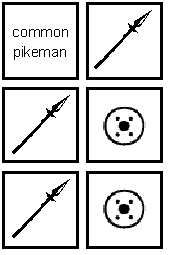 |
Sticker (Pikeman) The most common of the pikemen, this unit has great melee and save abilities, but not much else. If you're going to send your gnomes on the offensive, this unit is for you. It's one of the few gnomes without any maneuvers, so you'd better back it up with some units that can move. |
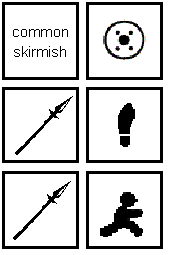 |
Stalker (Skirmisher) This common troop epitomizes the gnome skirmisher. If you count its ID icon and the Run Away SAI, this unit melees, saves, and maneuvers equally well. Its one real save is invaluable in preventing a total retreat to the reserves. It can also prattle well, but with its melee icons this unit is best suited for fighting. |
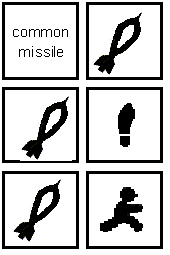 |
Tosser (Missile) Gnomes aren't known for their missile abilities, but with three missile faces, this unit will generate consistent results. It also maneuvers well, but saving (without running away) can be a problem. Unlike other races' missile troops, this unit can actually be of some use during a skirmish: counting its Run Away face, it can successfully prattle 2 times out of 6, hurling insults almost as well as it tosses darts. |
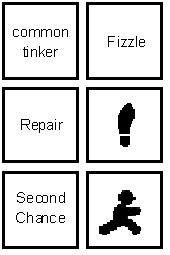 |
Inventor (Tinker) This common tinker is a good representative of the tinker class, having one maneuver, one Run Away SAI, and three tinker SAIs: two good, one not-so-good. But this unit is fairly harmless (as far as tinkers go), is not likely to cause too much damage, and is good for bringing magical items back into play. No army using magical items should be without at least a few of these units. Tinkers are great prattlers, engaging enemy troops in an endless stream of mind-numbing gibber-jabber, flaunting the merits of experimentation on magical items. (the faces are ID, Fizzle, Repair, Maneuver, Second Chance, Run Away) |
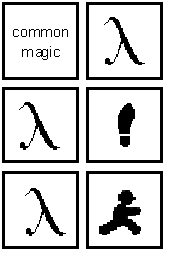 |
Visionist (Magic) The visionist can be counted on to generate magic consistently, even though it cannot generate as much as other races. Like all gnomes, it maneuvers quite well, something not often found in magic users. Of course, this unit also has a place during melee, rattling off theories on illusionary magic and the finer points of Giant Space Hamster breeding. |
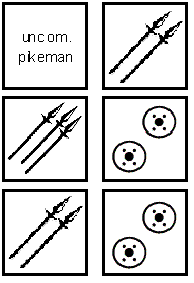 |
Poker (Pikeman) This unit is built for melee. Even with only 11 icons, this gnome can dish out scads of damage, and protect itself almost as well. As with all pikemen, this unit is slow, but can hold the line in melee. |
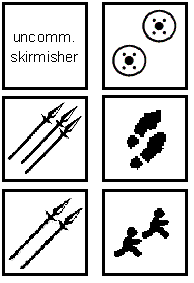 |
Ambusher (Skirmisher)
The uncommon gnome skirmisher is a great multi-purpose unit, generating lots of everything (except missile hits, but with gnomish accuracy, this might not be a bad thing). When it's time to move, this unit is nearly on par with other race's light infantry. Couting its Run Away and ID icons, it saves half of the time, making it hard to kill (but also hard to rally). |
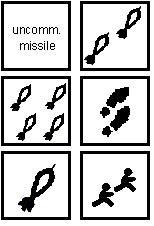 |
Thrower (Missile) What gnomish missile troops lack in accuracy they make up for in enthusiasm. Of course, you can't always count on the thrower to produce consistent results, but with 4 missile icons on a single face, who cares! Like most other gnomes, this unit also pulls its own weight when it comes to maneuvers. |
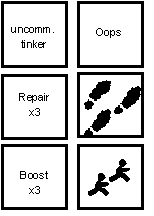 |
Engineer (Tinker) Here's where the fun starts. This unit packs the boost SAI, which can double the results of magical items - even SAI results! No other game effect can do that. Put this unit in an army with some rare magical items and watch the action begin. Of course, you do have to watch out for the Oops SAI as well, but the engineer can usually handle the damage, and those Repair SAIs can always be used to bring items back into play. (the faces are ID, Oops, Repair x3, Maneuve x3, Boost x3, Run Away x2) |
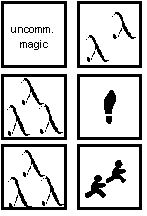 |
Phantasmist (Magic) The phantasmist is one of the slower gnomish units, but it's not lacking in magic power. Put a few of these units in your army, and the most powerful gnome illusions will be within your grasp. This unit also has good survivability, with a total of 4 saves (counting SAIs and its ID) |
.
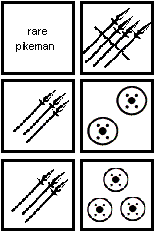 |
Impaler (Pikeman) This is one unit you would not want to see on the receiving end of a charge! Their skewer SAIs are absolutely deadly. Not even Open Grave can save a unit that finds itself dangling on the end of one of these awl pikes, and then the unit has to save to avoid being buried! Toss in five saves for good measure, and you have a gnome with a serious attitude! |
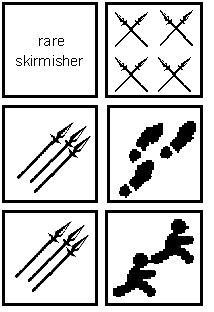 |
Breachgnome (Skirmisher) Like all gnome skirmishers, when it comes to hand-to-hand combat, the breachgnome does it all. This is a great addition to any melee army both as an attacker and as a defender. You won't find many units as versatile as the breachgnome. |
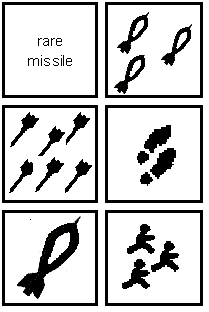 |
Barrager (Missile) Well, gnomish barragers aren't known for their consistency, but when they do manage to hit something, watch out! With its fusillade SAI, this unit can dish out 6 points of damage on a single face, and this damage can be spread out among multiple units (so much for all-common armies). |
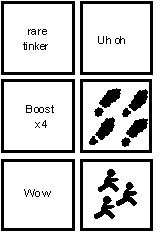 |
Professor (Tinker) Despite the high attrition rate of tinkers, it's not until a tinker becomes a professor that his activities begin to get really dangerous. Of course, the benefits outweigh the risks - usually. This unit can double 4 health-worth of magical item results - even SAIs - a real boost to armies with rare magical items and artifacts. For armies with smaller magical items, the Wow SAI adds 1 to all magical item results. Of course, common magical items are more likely to explode if (and when) an Uh oh gets rolled. (the faces are ID, Uh-oh, Boost x4, Maneuve x4, Wow, Run Away x3) |
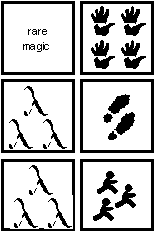 |
Illusionist (Magic) The most powerful of the gnomish magicians, the illusionist has quite an array of spells at its disposal - many of which are easily within reach of its 4-point cantrip. It has less magic than most other rare magicians, but no other race can cast the spells it can. |
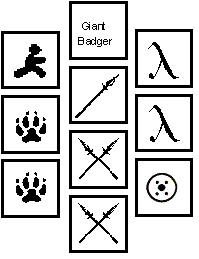 |
Giant Badger Not the bravest ally the gnomes have, the giant badger can nevertheless deliver a good counter-strike when defending itself. Like its feral-cousin, the giant badger has some magical abilities, which it has adapted to cast illusionary spells. |
|
|
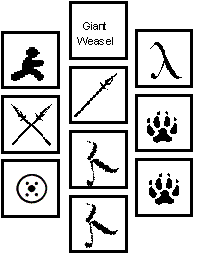
Giant Weasel Another relatively timid ally, the giant weasel rarely fights unless cornered. It moves well though, and has learned how to dispel magic as well as cast it, making it a good addition to any gnomish magic-using force. |
 |
|
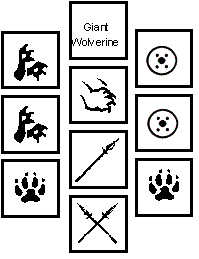 |
Giant Wolverine Don't ever call this a small furry creature! This thing's a melee animal! You'll never see a giant wolverine running away from battle. In fact, with all the re-roll potential of the rend and double-strikes, this ally may never stop fighting! |
|
|
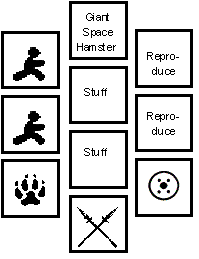
Giant Space Hamster This is, without a doubt, the most timid of the gnomish monsters. But since they breed in such great numbers - well, it seemed a shame not to bring them into battle (GSH meat is fairly tasty, after all). It might get lucky with a bite, but this creature is more likely to stuff your opponents' units in its cheek (until it finds something tastier). About the only thing they're really good at is staying in play, with 2 Run Away SAIs, two Reproduce SAIs, and even a real save. (the five faces written in text are ID, Stuff, Stuff, Reproduce, Reproduce) |
 |
|
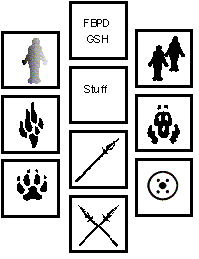 |
Fire-Breathing Phase Doggleganger Giant Space Hamster The rarest of the gnomish monsters, the FBPDGSH seems ridiculous - until you get to know it, that is. This creature wreaks utter chaos on the battlefield - surprising opponents, phasing in and out of armies, doppleganging, and breathing fire. Good thing this rodent is on your side! (the two faces written in text are the ID and Stuff) |
|
Is this kicker pack for real?
If it wasn't real, you wouldn�t be able to read this now, would you?
Seriously, are gnomes an official part of the game?
Seriously (if one can use that term in the same sentence as "gnome"), gnomes are not an official kicker pack for the Dragon Dice game. But we can dream�
What color are gnomes anyway?
Gnomes are a combination of red:fire, gold:earth, and blue:air. Basically, they're dwaves with air (air-headed dwarves?), as explained in the mythology in the beginning of this kicker pack.
How can I get gnomes?
You can make your own! You'll find the dice layouts in this kicker. I found that Avery 8167 labels are the perfect size to wrap around 3 sides of a common or uncommon die, so with two labels you cover all six sides. For rare dice, use Avery 5162 labels, cut into quarters. For monsters try using 1 1/4" round labels, cut into 5 sections. Just write the icons on the sides and you'll be all set.
What if I make a mistake putting the stickers on?
In keeping with the gnome spirit of adventure, discovery, and experimentation, if you accidentally put the wrong sticker on a gnome unit, it is legal in tournament play. However, if you intentionally create a misprint, that unit is subject to an immediate, automatic attack by the Giant Space Hamster of Ill Omen. It is entirely up to the judge as to what is intentional and what is accidental.
The Giant Space Hamster of Ill Omen (aka Wooly Rupert) is a unique gnome monster. It cannot be used in play, but can be instantly summoned by the judge in a gnome tournament. This monster is of unusual size (even larger than a Tyrannohamsterous Rex), is highly intelligent, and is said to possess spellcasting abilities. He is not well-disposed to gnomes of any sort, especially intentional misprints, preferring to squash them under his titanic paws. Gnomes everywhere fear the wrath of Wooly Rupert.
In tournament play, when a judge suspects an intentional gnome misprint, he may invoke the wrath of Wooly Rupert by merely mentioning his name. The judge then rolls a 10-sided dice and uses the chart below to determine Wooly Rupert's effect on the misprinted die:
|
1: ID |
5: Stomp SAI |
9: Stomp SAI |
|
2: Squash SAI |
6: Squash SAI |
10: Double Cantrip |
|
3: Mash SAI |
7: Mash SAI |
|
|
4: Grind-Under-Paw SAI |
8: Grind-Under-Paw SAI |
Icon Descriptions:
You get the idea.
What kind of roll is a prattle roll?
A maneuver roll. The prattling gnomes are treated as an army, so penalties to maneuvers (e.g., Transmute Rock to Mud) apply. SAIs that don't function during maneuver rolls (such as cantrip) are ignored.
What if a gnome rolls its ID during a prattle roll?
In this case, the ID does not count as maneuvers. It means the prattle attempt failed (miserably, in fact), and one of your opponent's units became enraged and attacked the prattling gnome. The gnome unit must immediately flee to the reserves.
Do gnomes have to prattle?
No. Prattling is optional, but it can be difficult for gnomes to resist the urge. You may elect to have any number of your gnome units prattle. Those that do not prattle and those that try to prattle but fail participate in the skirmish normally.
Can gnomes charge?
Yes, but most merchants will require a second form of identification when a gnome tries to charge (particularly if the customer is a tinker).
I mean in Dragon Dice!
Oh that! Yes, gnomes can participate in a charge action, but their maneuver icons do not count toward the damage total, only their melee results. Thus, if an army only contains gnomes, there's no reason to charge. In an army of mixed races, the non-gnome maneuvers count as damage, as normal.
Which magical items can tinker SAIs affect?
Tinker SAIs only affect those magical items are artifacts that have to be rolled. Artifacts and medallions always have to be rolled when their army rolls, but other magical items are rolled if and only if they generate the kind of result their army is currently rolling for.
In what order do the good and bad tinker SAIs take affect?
Uh oh is always applied first. It depends in the initial, unmodified roll of your magical items and artifacts. After that, you can apply the tinker SAIs (good and bad) in any order you wish.
How can Boost double SAI results?
This is an exception to the rules, as SAIs cannot normally be modified. But leave it to the tinker gnomes to figure out a way to do it. Double an SAI by pretending you had two identical magical items and each one rolled the same SAI.
What units can be doppleganged?
Any unit that is currently in play (part of an army either at a terrain or in the reserves). Dead units, buried units, units in the promotion pool, and unsummoned dragonkin cannot be doppleganged, since they are not in play.
When do Run Aways count as saves?
Whenever a unit is rolling for saves (either individually or as part of an army), it can optionally count its Run Away results as saves. However, that unit must immediately retreat to the reserves (before the current action is resolved). Thus, a unit rolling a run away can contribute to an army's total save results, even though the unit itself is not part of the army once those save results are resolved. Admittedly, this sequencing is very unusual (the only other SAI with a similar effect is Vanish).
Doesn't running away make gnomes mutation fodder?
And your point is?
What happens if I roll Run Away while in the reserves?
Then the unit retreats into the promotion pool�NOT! Run aways optionally count as saves when rolled in reserves, but the unit does not retreat further; it remains in the reserves.
When does Phase work?
Phase works during all rolls made by the unit, either individually or as part of an army.
Is the sequencing of Phase similar to that of Run Away and Vanish?
Yes. The results generated by the phasing unit are added to the army's total, and then the unit may phase to another army before the results are resolved.
When is the movement effect of Phase optional?
This effect is optional if the unit rolling the phase is rolling individually, or is part of the army that is currently rolling. When the phasing unit originates from an army other than the rolling army and phases in to join in the current roll, it must phase back to its original army after it rolls.
Is the "improve" ability of Repair similar to the promotion of units?
Yes. The rules for magical item improvement are similar to the rules for unit promotion, but color and function (e.g., melee, missile, magic) are not considered when making improvements. Rare magical items can be improved into artifacts.
If I bring a new magical item into play with the Repair SAI, do I roll it and count its results as well?
Yes. A new magical item brought into play is immediately rolled and counted in the current roll (just like units brought back into play with the Regenerate SAI). If you choose to improve a magical item instead, the item you're taking out of play does not count its results with the army's, although the item you bring in is immediately rolled and counted.
Is Reproduce just like Rise from the Ashes?
Yes, it is identical to Rise from the Ashes.
Can anything save a unit that gets Skewered?
The only things that can save a unit that gets skewered are the Rise from the Ashes and Reproduce SAIs. Otherwise, a unit targeted by a skewer immediately goes to the dead unit area, even if the army is protected by a spell such as Open Grave or Leaving. It must then roll a save or be buried.
If a unit is stuffed in a cheek and the hamster is killed, what kind of save must the trapped unit roll?
Any save result at all. Since the unit is stuffed inside the hamster's cheek, racial bonuses (i.e., maneuvers counting as saves) no not apply during this save roll.
If a hamster's cheeks are full and it rolls Stuff-in-Cheek again, does it have to spit out one of the currently trapped units?
Yes, the spit-out is mandatory. However, you can choose which trapped unit gets spit out and which one remains trapped. Spit out units always return to their owner's reserves.
Can an invisible unit be forced to dispel its invisibility?
No. An invisible unit cannot be targeted by any effect. Its owner can choose to dispel the invisibility only if the army the unit is part of is making a roll. By participating in that roll, the spell is immediately broken. Invisible units can make individual rolls (such as a roll to dispel magic) without canceling their invisibility.
Can an invisible unit be mutated?
No. Invisible units (including units in an army under the effects of a Mass Invisibility spell) cannot be mutated.
Which units can be chosen as Shadow Monsters?
Any unit that is in play, the same as with the dopplegang SAI.
Can an invisible army be forced to dispel its mass invisibility?
No. An invisible army cannot be targeted by any effect. Its owner can choose to dispel the invisibility only if he or she wants the army to make a roll that it is not entitled to make. By participating in that roll, the spell is immediately broken. Individual units within an invisible army can make individual rolls (such as a roll to dispel magic) without dispelling the army's invisibility.
If I summon multiple Shadow Dragons to the same terrain and they're based on different color dragons, do they attack each other?
No. Shadow dragons never attack real dragons or other shadow dragons, regardless of color. They always attack the enemy armies at the terrain.
Can an army kill a shadow dragon?
No amount of damage can ever kill a shadow dragon. The enemy armies are only rolling to save against the damage the shadow dragon inflicted on them.
Does hallucinatory terrain prevent the doubling of magic due to a terrain's colors?
No, this spell does not actually remove any elements from the target terrain. It only distorts and hides the terrain features, making the units at that terrain unable to use their racial advantages.
How do you simulate the rarity of monsters in this kicker pack?
The Fire-Breathing Phase Doppleganger Giant Space Hamster (FBPDGSH) is the ultra-rare monster. So, no matter how much starting health your army is, you can never have more than one FBPDGSH. The Giant Space Hamster is rare, but it's also fairly useless, so there's no need to enforce rarity here. The Giant Wolverine is uncommon, and the Giant Weasel and Giant badger are common.